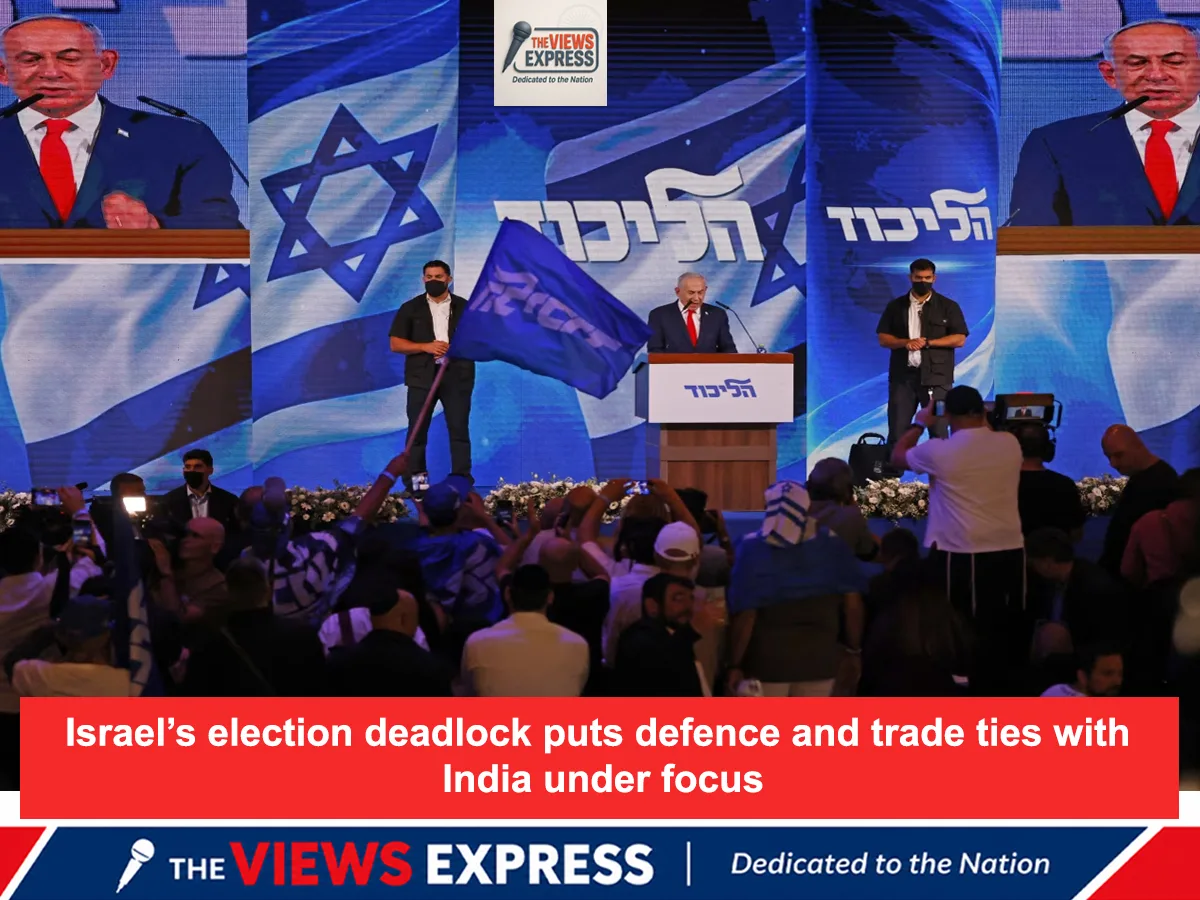

Israel’s general election has ended without a clear parliamentary majority for Prime Minister Benjamin Netanyahu’s bloc, creating uncertainty over the country’s next government. With all votes counted, Netanyahu’s bloc has secured 53 seats in the 120-member Knesset, while the opposition grouping led by Gadi Eisenkot has won 48. The two Arab-led parties have together secured 19 seats. A minimum of 61 seats is needed to form a government.
The result is important for India because its relationship with Israel has expanded well beyond traditional diplomacy. Defence cooperation, advanced technology, agriculture, water management and trade are key areas of partnership between the two countries.
In February 2026, India and Israel upgraded their relationship to a Special Strategic Partnership. They also announced plans to strengthen defence production and technology transfers, work towards a free trade agreement and expand cooperation in artificial intelligence, cybersecurity and agricultural innovation. Any prolonged political uncertainty in Israel could slow negotiations and the implementation of some proposed projects.
However, the election result does not automatically mean that these agreements will be cancelled.
For India, continuity in defence supplies, joint research and technology cooperation will be important. Israel is also a significant partner in agricultural technology and water-management solutions, areas that can benefit Indian farmers and industries.
There is another diplomatic concern. India maintains important relations with Israel as well as Arab countries. A more hardline government or renewed regional tensions could make this balancing act more difficult.
The final count is complete, but formal certification is expected on November 4. Coalition talks will determine who forms the next government. For India, the key issue will be whether strategic cooperation continues smoothly despite Israel’s political deadlock.