
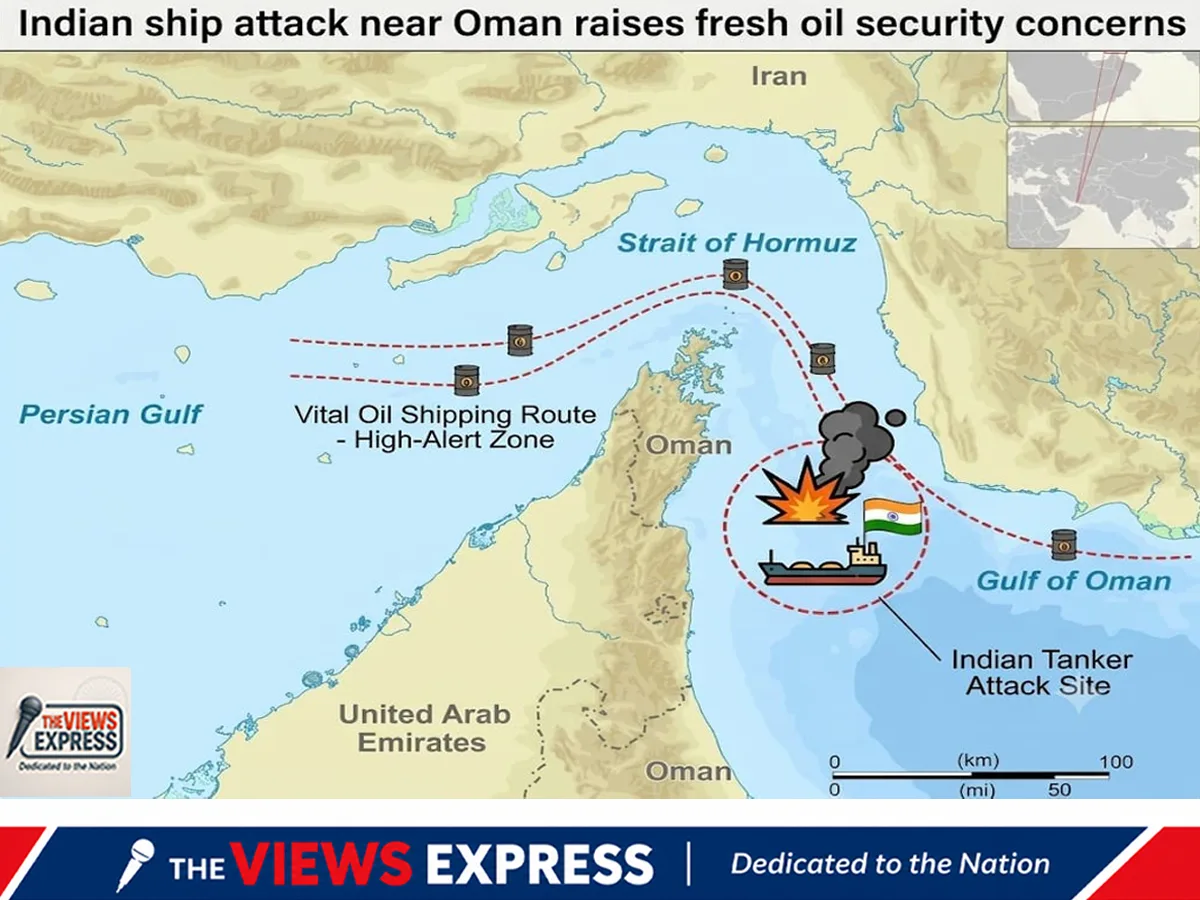

An attack on an Indian-flagged cargo vessel off the coast of Oman has raised fresh concerns about the safety of Indian sailors and the security of an important global oil route. The incident also comes amid growing tensions surrounding the Strait of Hormuz, a key passage for international oil shipments.
On November 2, the Indian vessel MSV Al Jusufi, carrying 14 Indian crew members, was struck by an unidentified aerial object near the Omani coast. According to the Ministry of External Affairs (MEA), 13 crew members were rescued, while one Indian sailor from Gujarat, Gandhar Nahim Ajij, died after sustaining injuries. The Omani Coast Guard carried out the rescue operation. The identity of those responsible for the attack has not been established.
Meanwhile, Iranian lawmaker Amir Hayat-Moghaddam has claimed that ships from India, China, Iraq and Qatar are exempt from restrictions on crossing the Strait of Hormuz. However, this is a statement by an Iranian parliamentarian, not an official confirmation from the Indian government.
Why does Hormuz matter to India?
The Strait of Hormuz connects the Persian Gulf with the Gulf of Oman and the Arabian Sea. A significant share of India's crude oil imports passes through this route. Any prolonged disruption could increase transportation costs, create supply concerns and put pressure on international oil prices.
On November 4, petrol in Kolkata was priced at ₹113.51 per litre, with no change reported. The reference Brent crude price of $106.61 per barrel should be treated as a reported market level, not an automatic indication of an immediate petrol price increase.
For ordinary consumers, the key concern is whether tensions continue and whether global oil supplies face prolonged disruption.