
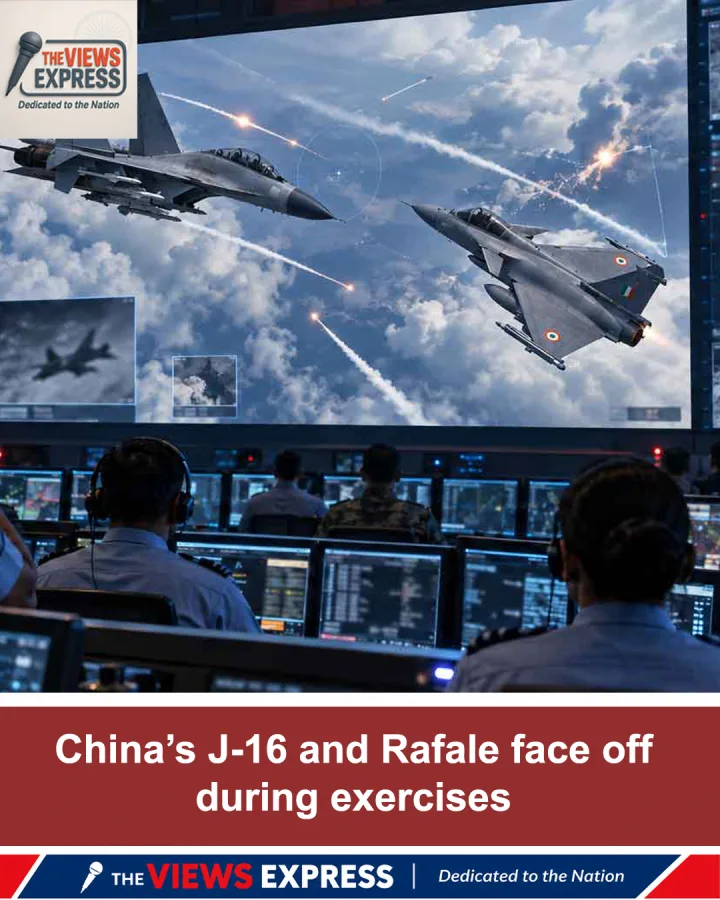

China’s attempt to study the Rafale fighter jet during a military exercise in Egypt could reportedly create an unexpected intelligence advantage for India, according to defence analysts. The Chinese Air Force deployed its J-16 fighter aircraft alongside support platforms for exercises with Egypt, which operates French-made Rafales.
The exercise, which began on August 21, was reportedly aimed partly at understanding the Rafale’s capabilities and identifying potential weaknesses. China deployed a sizeable package of aircraft, including fighters, tankers, an airborne early-warning and control aircraft and electronic-warfare platforms, highlighting its long-range force-projection capabilities.
However, analysts suggest the exercise could also provide valuable information about the J-16 to Rafale operators. One key factor is the Rafale’s SPECTRA electronic-warfare suite, designed to detect, identify and respond to electromagnetic threats. During operations, electronic signatures associated with hostile radar systems can potentially contribute to threat databases used for electronic warfare.
If data generated during multinational exercises is shared through established defence and technology channels, Rafale operators such as India could potentially benefit from broader information about Chinese systems. Such intelligence could help Indian planners better understand Chinese radar and electronic signatures.
The exercise may also reveal how China coordinates fighters with tankers, AWACS and electronic-warfare aircraft during distant operations.
At the same time, experts caution against assuming that Egypt’s Rafale configuration is identical to India’s. Indian Rafales have distinct weapons, sensors, software and operational configurations. Therefore, intelligence gained by China from Egyptian Rafales may not directly translate into an advantage against India.
The episode nevertheless underlines the growing importance of electronic warfare and battlefield data in modern air combat.