
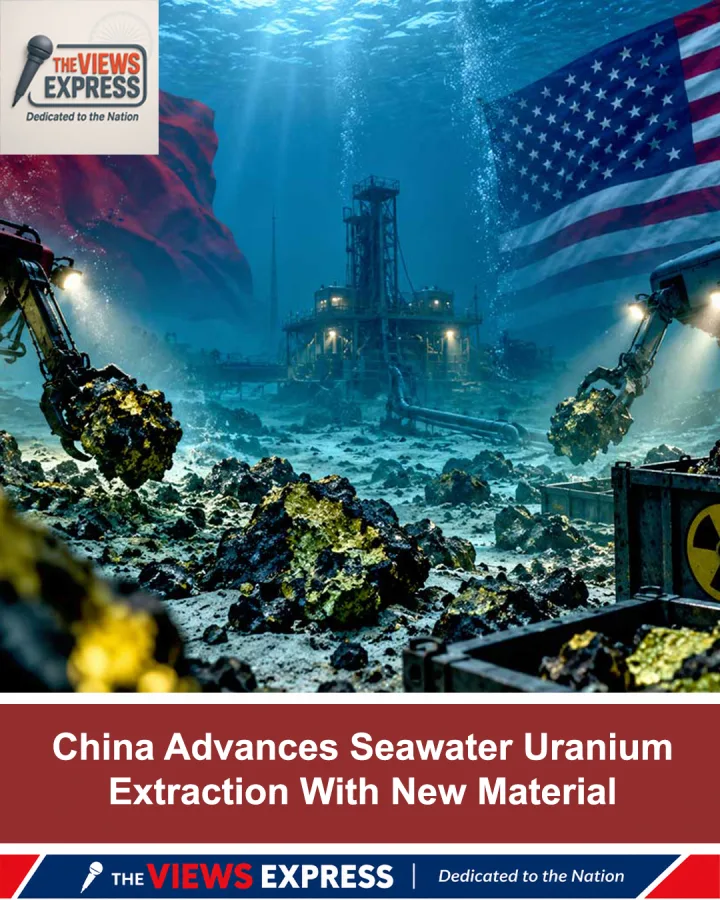

China’s efforts to secure alternative uranium resources have reportedly taken a significant step forward, with researchers developing a specialised material designed to capture uranium from seawater. The development could potentially support the country’s long-term nuclear energy ambitions, although large-scale commercial extraction remains a major challenge.
According to Chinese media reports, researchers associated with the Chinese Academy of Sciences have developed a sponge-like molecular structure called “PhosCage”. The material contains phosphate groups capable of chemically binding uranium, allowing the element to be separated from seawater.
Laboratory experiments reportedly showed that the material could extract up to 50.4 milligrams of uranium per gram of the material from seawater samples. Chinese researchers claim this performance is about eight times higher than an experimental benchmark reported from the United States.
Uranium extraction from seawater has long been considered technically difficult because the concentration of the element is extremely low. Around 3.3 milligrams of uranium are estimated to be present in every tonne of seawater, alongside other elements such as vanadium that can complicate the separation process.
Researchers are therefore focusing on materials capable of selectively capturing uranium while limiting interference from other substances. The reported PhosCage technology is intended to address this challenge.
The oceans are estimated to contain vastly more uranium than known terrestrial reserves. While land-based uranium resources are estimated at millions of tonnes, seawater is believed to contain billions of tonnes dissolved in extremely dilute concentrations.
If the technology can eventually be scaled economically, it could offer an additional source of nuclear fuel. However, further testing will be needed to determine its efficiency, durability and commercial viability in real-world ocean conditions.