
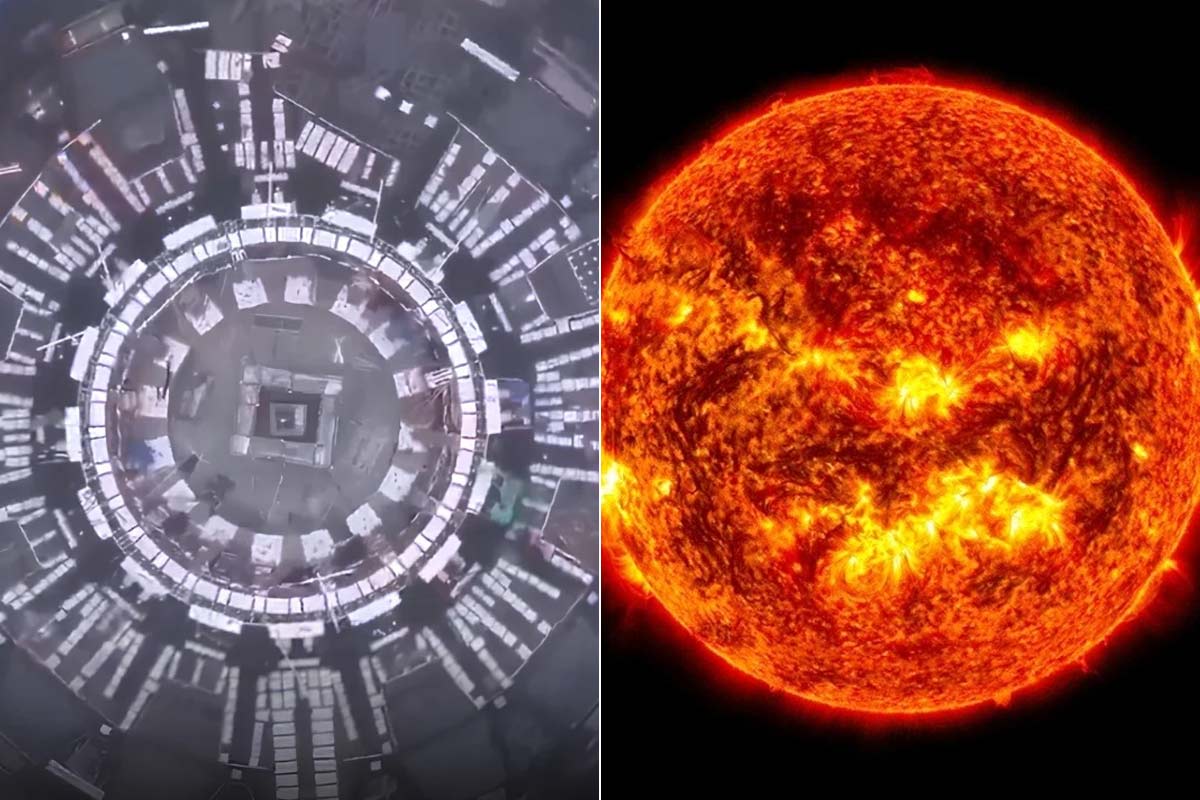

China has taken another significant step toward developing its ambitious "Artificial Sun" project, bringing the world closer to a future powered by clean and nearly limitless fusion energy. The latest milestone comes with the successful development and testing of the world's largest superconducting fusion magnet, a critical component required for operating a nuclear fusion reactor.
The magnet, developed by the Institute of Plasma Physics under the Chinese Academy of Sciences, is D-shaped, measuring 21 meters in length, 12 meters in width, and weighing an enormous 582 tons. According to Chinese researchers, it is approximately 1.3 times larger than comparable superconducting magnets built for the International Thermonuclear Experimental Reactor (ITER) and can store nearly three times more magnetic energy.
Unlike conventional nuclear power, the Artificial Sun is based on nuclear fusion—the same process that powers the Sun. By fusing hydrogen atoms at temperatures exceeding 100 million degrees Celsius, fusion reactors can generate vast amounts of energy without producing carbon dioxide emissions, making the technology one of the most promising sources of future carbon-free electricity.
Earlier this year, China's Experimental Advanced Superconducting Tokamak (EAST), often referred to as the country's Artificial Sun, set a world record by sustaining plasma at around 100 million degrees Celsius for 1,066 seconds. Scientists consider that achievement a major technological breakthrough and a stepping stone toward commercial fusion energy.
China now aims to generate electricity from fusion power by 2030. If successful, the project could revolutionize global energy production by providing a safer, cleaner, and virtually unlimited alternative to fossil fuels, while accelerating the transition toward sustainable and environmentally friendly power generation.