
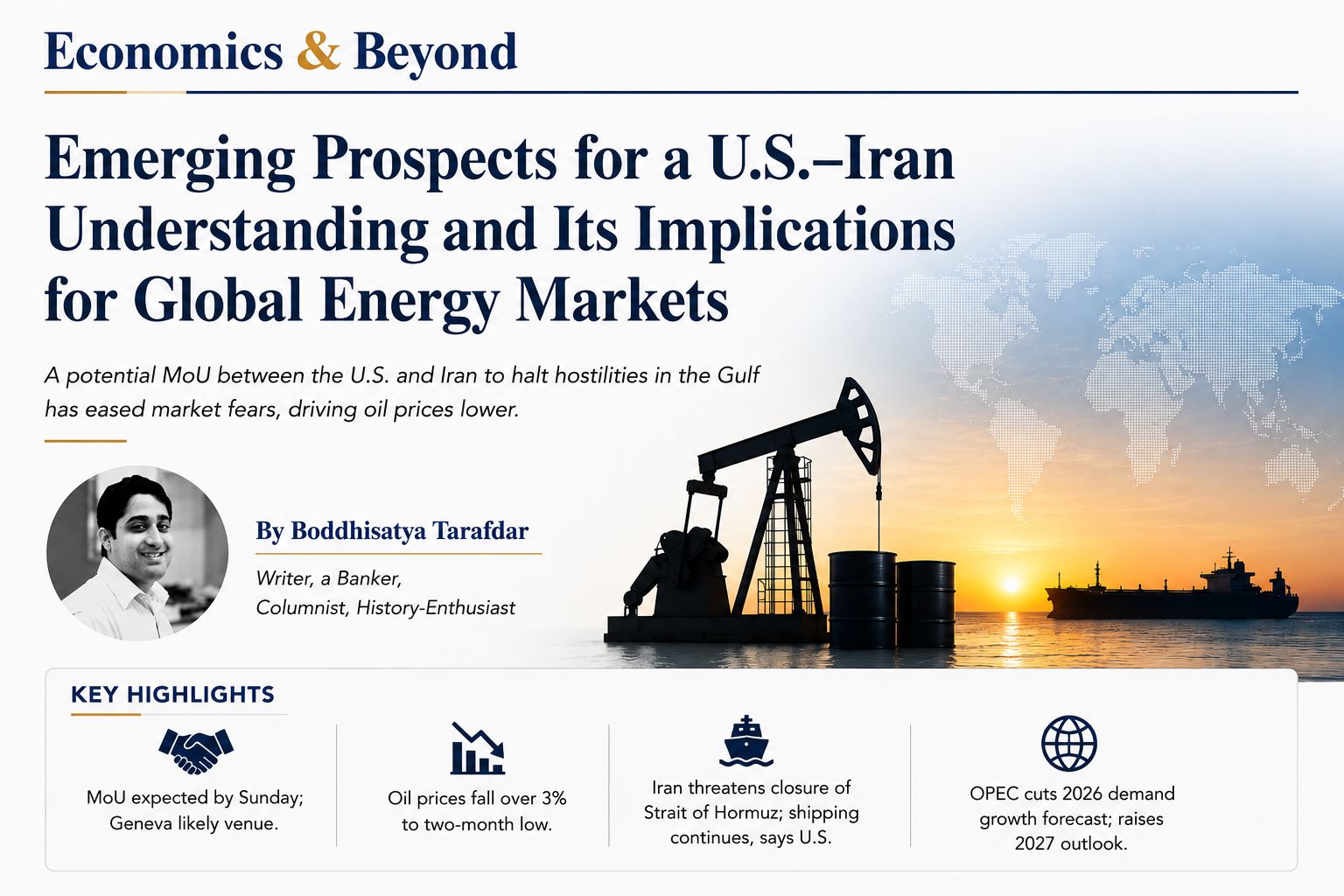

The Persian Gulf has long been a focal point of international geopolitical tensions due to its strategic significance and vast hydrocarbon resources. Relations between the United States and Iran have frequently oscillated between confrontation and cautious diplomacy. Recent news reports suggesting that Washington and Tehran may sign a Memorandum of Understanding (MoU) by Sunday have generated considerable attention among policymakers, economists, and energy analysts worldwide. Geneva has emerged as the most likely venue for the proposed agreement, reflecting the city's longstanding role as a neutral platform for international negotiations. The reported discussions come after a period of heightened tensions marked by reciprocal military actions and threats of further escalation.
As per reports, U.S. President Donald Trump decided on Thursday to cancel previously threatened military strikes against Iran. This decision was interpreted by international observers as a significant de-escalatory step, opening the door for renewed diplomatic engagement. Simultaneously, Iran's Mehr News Agency reported that the final round of negotiations concerning the proposed MoU would concentrate primarily on nuclear and economic matters. Notably, Iranian officials indicated that discussions regarding the country's ballistic missile programme would remain outside the scope of the agreement. This exclusion highlights one of the most persistent areas of disagreement between Tehran and Western powers. The focus on nuclear and economic issues suggests an effort by both parties to address the most immediate sources of tension while avoiding subjects that could potentially derail negotiations. Such a limited-scope agreement may serve as a confidence-building measure, creating conditions for broader dialogue in the future.
Financial markets responded swiftly to the prospect of reduced hostilities. International oil prices fell by more than 3% on Friday, reaching their lowest levels in nearly two months. The decline reflected investor expectations that the likelihood of a major disruption to Middle Eastern oil supplies had diminished significantly. Energy markets are particularly sensitive to developments involving Iran due to the country's strategic location and its influence over key shipping routes. The cancellation of threatened U.S. military action reduced fears that the conflict could escalate into a broader regional confrontation affecting oil production and transportation.
The sharp decline in prices demonstrates how geopolitical risk premiums are incorporated into commodity markets. When the possibility of conflict increases, traders typically anticipate supply disruptions and bid prices higher. Conversely, signs of diplomatic progress tend to reduce uncertainty and place downward pressure on prices. Despite positive diplomatic signals, concerns regarding maritime security remain substantial. Iran announced the closure of the Strait of Hormuz and warned that it would target vessels attempting to navigate the waterway. The announcement drew immediate international attention because the strait serves as one of the most important energy transit routes in the world.
The geopolitical developments coincided with the release of updated forecasts from the Organization of the Petroleum Exporting Countries (OPEC). The producer group revised downward its projection for global oil demand growth in 2026, reducing the expected increase from 1.17 million barrels per day (bpd) to 970,000 bpd. This marks the second consecutive downward revision, reflecting concerns about global economic growth and evolving energy consumption patterns. The revised forecast suggests that demand growth may be moderating in the medium term, influenced by factors such as energy efficiency improvements, economic uncertainties, and the gradual expansion of renewable energy sources.
The prospect of a U.S.–Iran Memorandum of Understanding represents a potentially significant development in Middle Eastern diplomacy. By focusing on nuclear and economic issues while setting aside more contentious subjects such as missile capabilities, both sides appear to be pursuing a pragmatic approach aimed at reducing immediate tensions. The reaction of global oil markets underscores the profound influence of geopolitical developments on energy prices. While diplomatic progress has eased concerns and contributed to lower oil prices, uncertainty surrounding the Strait of Hormuz continues to highlight the vulnerability of global energy supply chains. At the same time, OPEC's revised demand forecasts reveal the complex interplay between geopolitical events and long-term market fundamentals. As negotiations continue, the outcome of U.S.–Iran discussions will likely remain a critical factor shaping both regional stability and the future trajectory of global energy markets.
Writer: Boddhisatya Tarafdar is a Banker, History Researcher & a Blogger. He usually writes on Indian History & contributes for the special section 'Economics & Beyond" on Economics & on International Relations
(Note: The OPINION section of The Views Express presents the articles or columns by individuals, where the writer exclusively writes on the matters of History, International Relations, Politics, Economy, Literature etc. on the basis of his or her opinion, knowledge, research & observations on the subject matter)

.jpg)


.webp)