
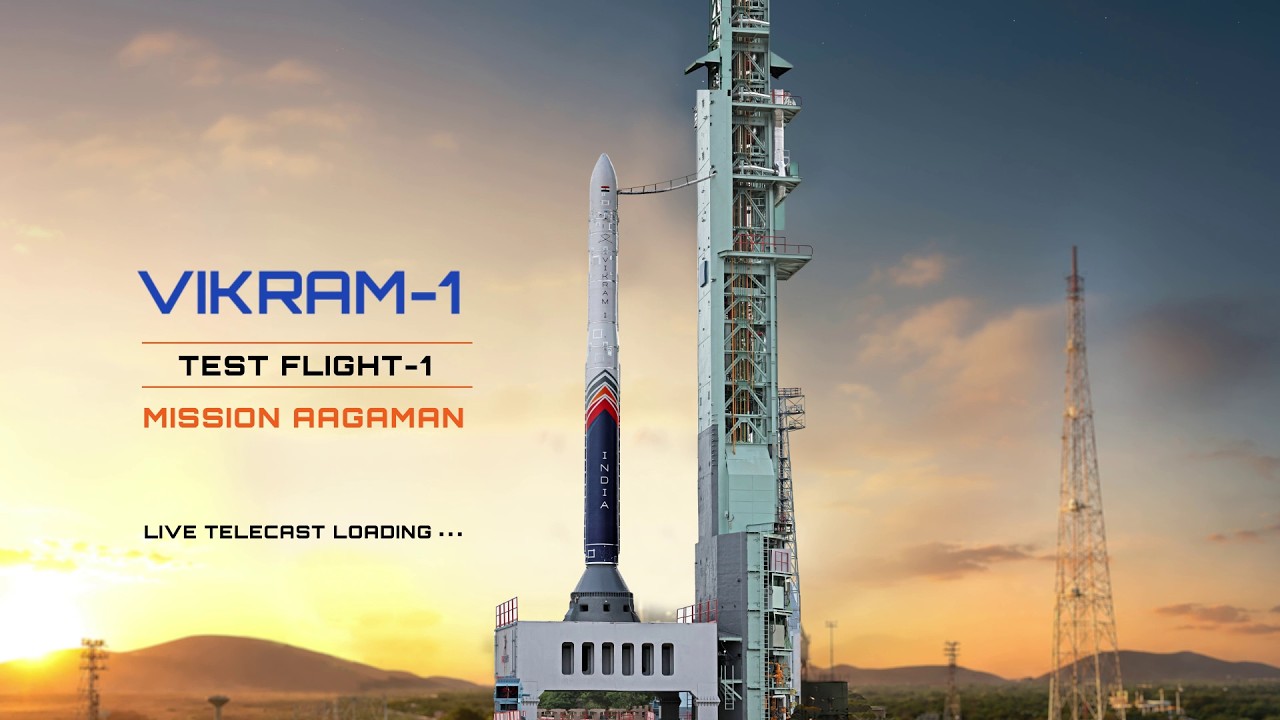
In a landmark achievement for India's rapidly expanding private space sector, Hyderabad-based Skyroot Aerospace on Saturday successfully launched Vikram-1, the country's first privately developed orbital-class rocket, placing six payloads into low Earth orbit (LEO) on its maiden mission.
The mission, named Mission Aagaman, lifted off from the first launchpad at the Satish Dhawan Space Centre, Sriharikota, at 12.05 p.m., after a brief technical interruption delayed the countdown by about 35 minutes. The final five minutes of the launch sequence were placed on hold due to a precautionary technical check, momentarily halting celebrations at the launch complex. Following a successful system review and restart of the countdown, the rocket blasted off flawlessly.
Vikram-1 successfully deployed all six payloads into the planned 450-km low Earth orbit with an orbital inclination of 60 degrees, marking the successful completion of Skyroot Aerospace's maiden orbital mission.
The achievement is being hailed as a watershed moment for India's private space industry. With the success of Mission Aagaman, Skyroot Aerospace has become the first Indian private company to develop and launch an orbital-class rocket into space, underscoring the country's growing capabilities in commercial space technology.
Founded by former ISRO scientists Pawan Kumar Chandana and Naga Bharath Daka, the Hyderabad-based startup has now entered an elite global group of both government agencies and private companies that have successfully achieved an orbital launch on their very first attempt.
The successful mission is expected to strengthen India's position in the global commercial space market and further accelerate private participation in the country's space programme under the government's space sector reforms.
The Vikram-1 launch also highlights the growing synergy between ISRO and India's emerging private space ecosystem, paving the way for more indigenous commercial launch vehicles and satellite missions in the years ahead.