
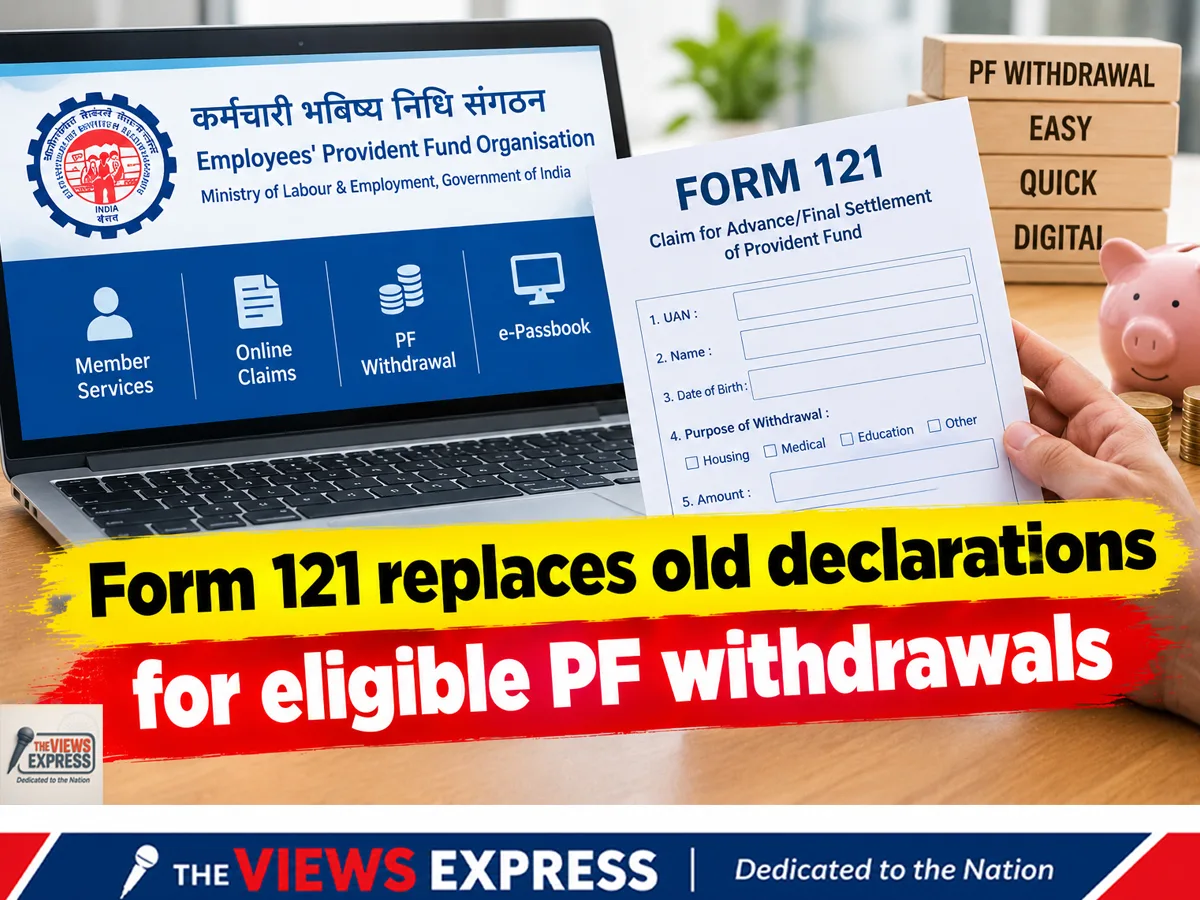

Employees planning to withdraw their Provident Fund (PF) savings should know about an important change in tax paperwork. From April 1, 2026, Form 121 has replaced Forms 15G and 15H under the Income-tax Act, 2025, and Income-tax Rules, 2026, according to the Income Tax Department and EPFO.
Who needs to submit Form 121?
Form 121 is a declaration for eligible taxpayers whose estimated tax liability for the relevant tax year is nil. It can help prevent tax deducted at source (TDS) on eligible payments, including certain PF withdrawals.
The new form combines the earlier Forms 15G and 15H. Eligible resident taxpayers can use the same form regardless of whether they are below or above 60 years of age. However, the eligibility conditions remain applicable. Non-residents, companies and firms cannot use this declaration.
When can TDS apply to PF withdrawals?
Withdrawing PF before completing five years of continuous service can have tax implications, subject to applicable rules and exceptions. Employees should check their service history and withdrawal circumstances before submitting a declaration.
Does Form 121 make the withdrawal tax-free?
No. Form 121 only helps prevent TDS when the taxpayer meets the eligibility conditions. It does not automatically exempt the withdrawal from income tax. If tax is payable on the income, the taxpayer must meet the applicable tax-filing and payment requirements.
Employees should consult the official Income Tax Department or EPFO websites before submitting the form.