
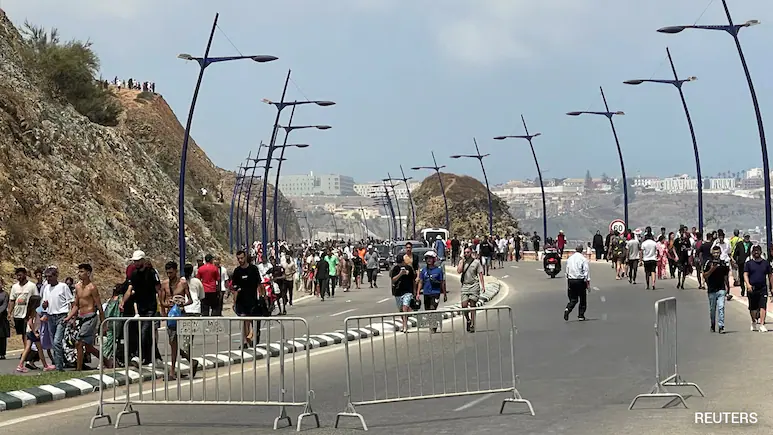

Spain has deployed additional troops and security personnel to its North African enclave of Ceuta after thousands of migrants crossed into the territory from neighboring Morocco, triggering renewed concerns over Europe's migration challenges. Many migrants reportedly entered by swimming around coastal barriers, while others crossed or climbed the heavily fortified border fence separating Ceuta from Morocco.
The mass crossing has also resulted in tragedy, with reports indicating that at least 15 people drowned while attempting the dangerous journey across the sea. Spanish authorities have intensified border security operations while humanitarian organizations continue to monitor the situation and assist those affected.
Ceuta is a small Spanish autonomous city located on the northern coast of Africa. Despite its geographical location, it is an integral part of Spain and the European Union. As a result, reaching Ceuta effectively provides migrants with access to EU territory, making it a key destination for people seeking safety, employment, or improved living conditions in Europe.
The enclave has long been one of Europe's most sensitive migration hotspots. Thousands of migrants from Africa and other regions attempt to reach Ceuta each year, often risking their lives to escape conflict, poverty, political instability, or economic hardship. Many begin their journey from the Moroccan town of Fnideq or nearby coastal villages before attempting to swim or scale the border fence.
Ceuta also remains politically sensitive, as Morocco does not recognize Spanish sovereignty over the enclave and continues to claim both Ceuta and nearby Melilla as Moroccan territory. The latest surge underscores the complex intersection of migration, border security, humanitarian concerns, and longstanding diplomatic tensions in the region.