It is often observed that, for making cities “encroachment-free,” municipal or government authorities periodically remove small roadside shops, mobile carts, hawkers, and street vendors from roads and lanes across urban centres in our country. While such drives are usually conducted on the grounds of improving traffic flow and urban aesthetics, but they often overlook a crucial reality: these small enterprises are a vital source of employment and livelihood for thousands of poor and lower-income families in a country already grappling with high levels of unemployment and economic insecurity.
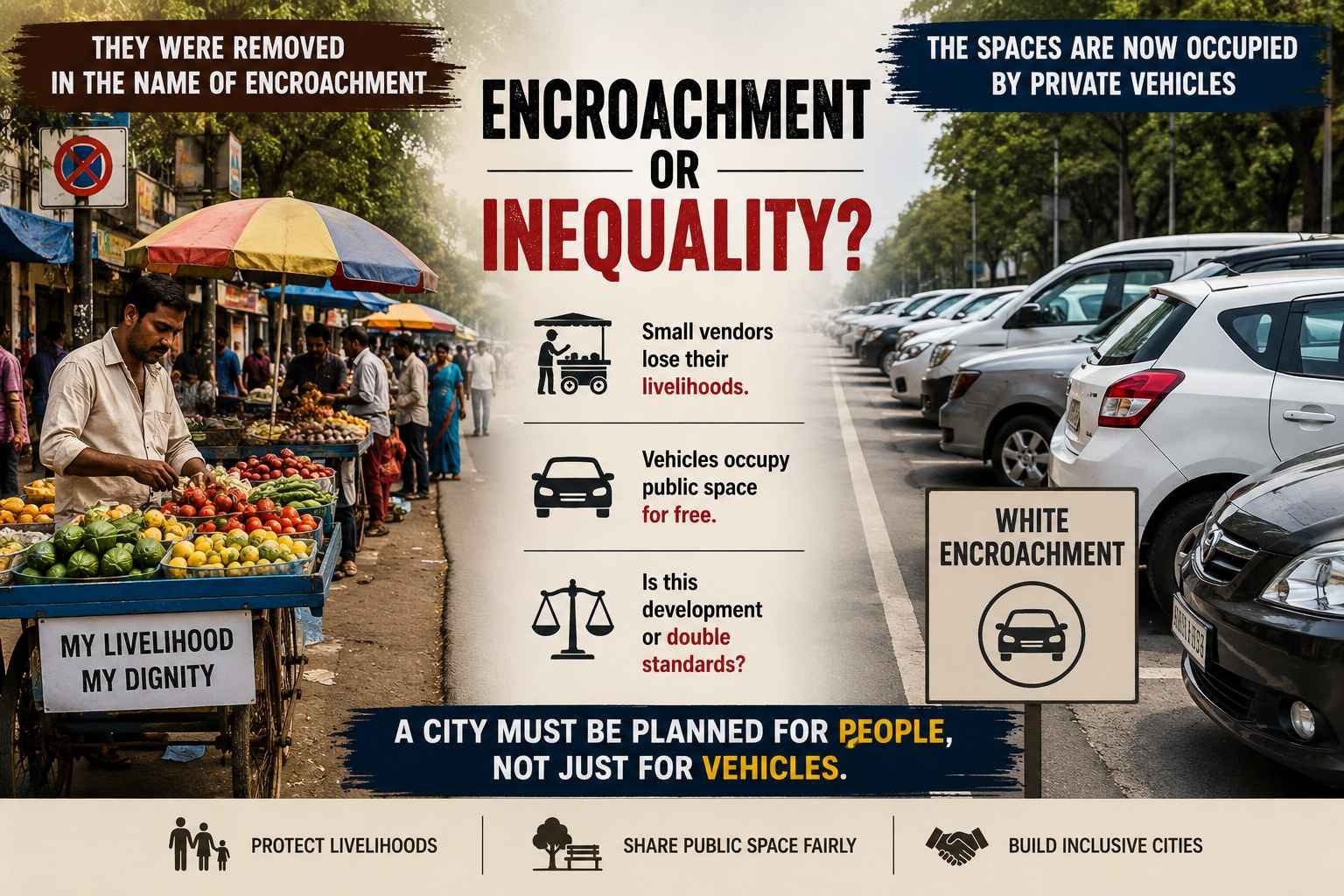
What is particularly striking is what happens after these evictions. In many cases, the spaces cleared of vendors are soon occupied by parked cars, motorcycles, autos, and other private vehicles. These vehicles, too, are making prolonged use of public roadside space, even though such spaces were never intended to serve as permanent parking areas. The result is an unfortunate paradox: the poor are displaced in the name of removing encroachments, while the affluent indirectly benefit through expanded parking opportunities and easier access for private vehicles.
Today, the occupation of public roadsides by parked vehicles is widely accepted as normal and rarely questioned. Yet, if we examine the issue objectively, this practice can also be viewed as a form of encroachment—what may be termed “white encroachment.” The concept challenges the conventional perception that encroachment is limited only to street vendors and informal businesses. A truly honest assessment of public-space usage must recognise that long-term occupation of roadsides by private vehicles is equally a private appropriation of public land.
A walk through many neighbourhoods and local streets clearly reveals this reality. Areas once occupied by small vendors are now frequently lined with parked cars, motorcycles, and auto-rickshaws. The public space has not necessarily been reclaimed for pedestrians or community use; rather, it has often been transferred from one group of users to another, with the latter enjoying greater economic and social privilege.
This raises important questions of fairness, equity, and social justice. Urban development, traffic management, and beautification are undoubtedly important objectives, but they should not come at the cost of destroying livelihoods and deepening unemployment. A balanced and humane approach to urban planning must recognise both the right to mobility and the right to livelihood. Cities should strive to accommodate vendors through well-planned vending zones, regulated use of public space, and inclusive policies rather than relying solely on eviction-driven solutions.
We frequently advise small vendors that they should conduct business only from designated locations, rent commercial premises, or purchase shops before operating. If that principle is considered valid, should it not also apply to vehicle owners? Why is the long-term occupation of public space by private vehicles treated as acceptable, while the use of the same space for earning a livelihood is deemed an encroachment? Should vehicle owners not also be expected to arrange designated parking spaces rather than relying on public roads as free storage areas?
Unless urban planners, policymakers, and citizens are willing to confront this imbalance, our understanding of encroachment will remain selective and incomplete. A truly encroachment-free city cannot be achieved merely by removing the poor from public spaces while overlooking the equally significant occupation of those spaces by private vehicles. It is time to broaden our perspective and acknowledge the phenomenon of “white encroachment,” ensuring that urban governance is guided not only by efficiency and aesthetics but also by fairness, inclusivity, and social justice.
Author: Shri Himanshu Bhusan Palei is a Govt. of Odisha official
(In the OPINION page the experts express their opinion on perticular topics of importance)
The Views Express is a news website, we truely believe in presenting & analysing the news that really matters to the people in general.
: +91 9836903612
: theviewsexpress@gmail.com
info@theviewsexpress.in
Mrinmoy Banerjee - Editor In Chief
Moumita Tarafdar - Managing Editor
Supriyo Mukherjee - Associate Editor
Anindya Das - Associate Editor (Honorary)
Copyright © 2024 The Views Express, All Rights Reserved. Developed by PRIGROW


.jpg)