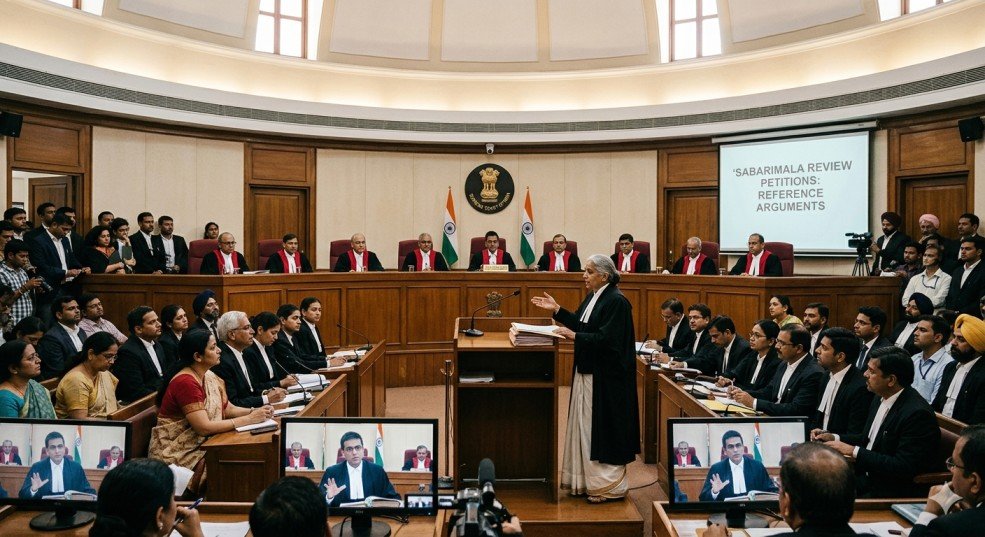
New Delhi — In a pivotal moment for Indian jurisprudence, the Supreme Court of India has resumed hearing substantive arguments in the highly contentious Sabarimala review petitions. A nine-judge Constitutional Bench, led by Chief Justice D.Y. Chandrachud, is addressing critical questions that extend far beyond the entry of women into the hill shrine, probing the complex interplay between religious autonomy, the right to equality, and the powers of judicial review in matters of faith.
The atmosphere within Courtroom 1 was charged as senior advocates presented nuanced arguments over two days. At the heart of the matter are conflicting constitutional provisions: Article 14 (Equality before Law) vs. Article 25 and 26 (Freedom of Religion and Right to Manage Religious Affairs). The debate has centered on whether traditional practices, however discriminatory they may seem, should be shielded under the umbrella of 'essential religious practices' (ERP).
The petitioners challenging the ban on women of menstruating age argue that such a restriction is inherently discriminatory and violates basic human dignity. Senior Advocate Indira Jaising contended that "menstruation is not a ground to exclude women from religious practices," emphasizing that the Constitution is a dynamic document designed to purge society of entrenched prejudices. She argued that traditional practices, when they clash with fundamental rights, must yield to constitutional morality.
Conversely, the lawyers representing the Travancore Devaswom Board and the Thanthri (head priest) strongly defended the practice, describing it as an essential and core tenet of the unique deity, Lord Ayyappa, who is worshipped as a Naishtika Brahmachari (eternal celibate). Adv. J. Sai Deepak, representing the deity itself, argued that judges should be circumspect when interpreting theological matters. He stated, "The unique form of the deity demands unique rules. These are not general restrictions on women, but specific rules for this specific deity," cautioning that excessive judicial intervention could "de-spiritualize" temples and erode religious pluralism.
The Bench, while listening intently, posed sharp questions to both sides. The justices queried whether the court could test 'essential religious practices' without a profound understanding of theology and whether a practice deemed discriminatory automatically becomes unconstitutional.
The final verdict, which is eagerly awaited by both religious conservatives and progressive activists, will not only dictate the rules of entry for the Sabarimala shrine but will also establish a critical precedent for future conflicts involving faith and fundamental rights in India's multicultural democracy. The proceedings continue, promising deep philosophical debates on the soul of the Constitution.
The Views Express is a news website, we truely believe in presenting & analysing the news that really matters to the people in general.
: +91 9836903612
: theviewsexpress@gmail.com
info@theviewsexpress.in
Mrinmoy Banerjee - Editor In Chief
Moumita Tarafdar - Managing Editor
Supriyo Mukherjee - Associate Editor
Anindya Das - Associate Editor (Honorary)
Copyright © 2024 The Views Express, All Rights Reserved. Developed by PRIGROW