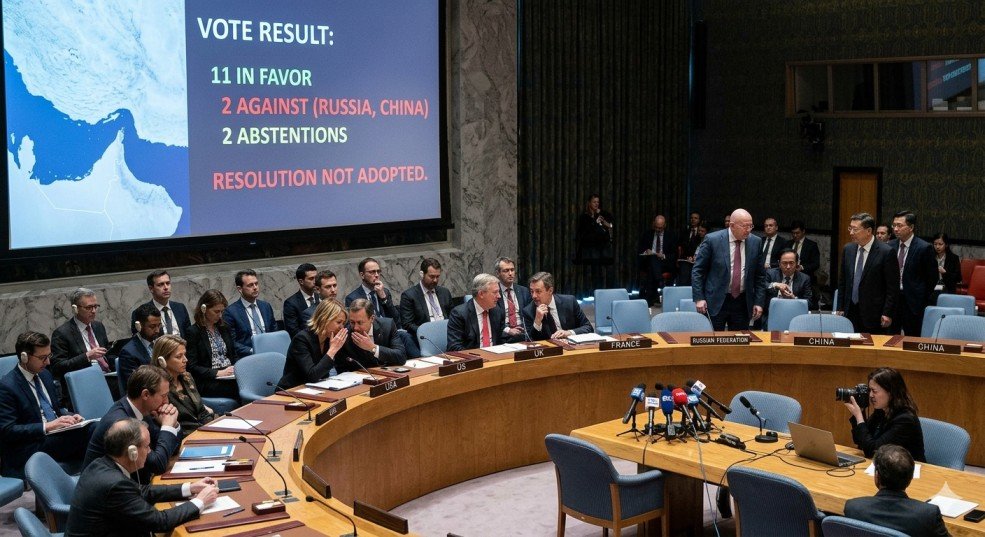
The United Nations Security Council, often viewed as the definitive body for maintaining global peace and security, has failed to act as a crucial resolution addressing the escalating crisis in the Strait of Hormuz was vetoed by both Russia and China. This joint action highlights a deepening rift among major powers and places significant obstacles in the path of a peaceful, unified international response to one of the world's most critical maritime choke points.
The resolution, proposed by a coalition of nations seeking to de-escalate tensions and ensure the safe passage of commercial vessels, sought to condemn recent attacks on oil tankers and establish a international monitoring mission within the strategic waterway. The move came in response to a string of incidents involving the seizure and harassment of shipping, which many nations have attributed to regional actors. However, both Russia and China, exercising their permanent-member veto power, blocked the resolution, effectively bringing all diplomatic momentum at the UN to a sudden and definitive halt.
Russia's UN ambassador, speaking prior to the vote, expressed deep reservations about the resolution's language and intent. He argued that the proposal was inherently biased, pointing fingers prematurely and failing to properly acknowledge the legitimate security concerns of all regional players. "We cannot support a text that escalates rather than calms the situation," the ambassador stated. "The international community must pursue a path of inclusive dialogue and diplomacy, not one that leans towards coercion and unilateral condemnation."
Similarly, the Chinese representative articulated a stance rooted in non-interference and a preference for regional solutions. "China is deeply concerned about the situation in the Strait of Hormuz, but we believe that regional issues are best resolved through the constructive efforts of the countries involved," the ambassador said. "An externally imposed monitoring mission, particularly one that lacks the consent of key regional stakeholders, could exacerbate existing tensions and lead to unintended and potentially dangerous consequences."
The United States, a staunch supporter of the resolution, expressed profound disappointment and labeled the vetoes as a dereliction of responsibility. "The failure of the Security Council to act in the face of blatant threats to international maritime security is deeply troubling," a US official remarked. "By blocking this resolution, Russia and China are enabling further instability and jeopardizing the global economy." The official added that the US and its allies would explore all alternative options to safeguard the freedom of navigation and protect crucial energy supplies.
The blockage of the resolution has amplified fears of a further escalation of the crisis. Without a cohesive international mandate, regional actors may feel emboldened, potentially leading to miscalculations and a wider conflict. The Strait of Hormuz is a vital conduit for approximately 20% of the world's total petroleum consumption, and any prolonged disruption to the flow of oil could have severe ramifications for the global economy. As the diplomatic path at the UN remains deadlocked, the world watches with mounting anxiety, hoping that de-escalation can be achieved through alternative channels before a significant crisis unfolds.
The Views Express is a news website, we truely believe in presenting & analysing the news that really matters to the people in general.
: +91 9836903612
: theviewsexpress@gmail.com
info@theviewsexpress.in
Mrinmoy Banerjee - Editor In Chief
Moumita Tarafdar - Managing Editor
Supriyo Mukherjee - Associate Editor
Anindya Das - Associate Editor (Honorary)
Copyright © 2024 The Views Express, All Rights Reserved. Developed by PRIGROW